EASE has provided a reply to the European Commission’s Public Consultation on the revision of the EU gas networks rules on market access addressing the Hydrogen and Gas Market Decarbonisation Package. EASE is preparing a response to this consultation to improve the Hydrogen and Gas Market Directive and Regulation proposal in a way that is favourable to the energy storage sector.
June 2021 / Policy Papers
Energy Storage in the Renewable Energy Directive III
EASE welcomes EU policymakers’ efforts to revise the Renewable Energy Directive II (RED II) as part of the ‘Fit for 55’ package, expected July 2021. Accelerating the deployment of renewable energy sources (RES) is essential to achieve the EU’s ambitious goals of a 55% GHG emissions reduction by 2030 and carbon neutrality by 2050.
However, simply deploying more RES is not enough; RES need to be integrated effectively into the system and their use in the heating and cooling, mobility, and industry sectors must be maximised.
Energy storage is a key enabler of a RES-dominated system. The transition to a renewable-based energy system needs to be supported by energy storage in order to ensure security of supply, efficient energy system operation, and the competitiveness of EU industries.
The revision of RED II as an important opportunity to reduce barriers to energy storage deployment, build on the provisions of the ‘Clean Energy for All Europeans’ Package, and position storage alongside RES as the backbone of the energy system. EASE proposes several key recommendations for the RED III:
Commit to a higher level of ambition in order to deliver on the EU Green Deal and the 2030 and 2050 decarbonisation targets. Increase the overall Union target for renewable energy in 2030 to 38-40% and make it binding both at EU and national level.
Define a comprehensive methodology to assess flexibility needs, which could be used to define an energy storage target to support the cost-effective integration of RES.
Revise Articles 4 and 5 of RED II on RES support schemes to explicitly include energy storage projects and incentivise projects that co-locate storage and renewables.
Reduce barriers to deployment of hybrid RES + storage projects.
Simplify and accelerate administrative procedures and permitting for energy storage facilities.
Support the deployment of thermal energy storage, both large-scale and small-scale, to help achieve the targets for RES in heating and cooling.
Add a renewable hydrogen definition encompassing all of its potential uses.
Ensure that together, the revised Third Energy Package for Gas and RED III provide a clear certification system for renewable and low-carbon hydrogen.
Expand articles 21 and 22 on renewable self-consumers and renewable energy communities to incentivise smart charging and vehicle-to-grid applications, which can maximise the uptake of RES in transport.
EASE looks forward to working with policymakers to ensure that the RED III helps unleash the full potential of energy storage solutions to enable the cost-effective integration of very high shares of renewables.
EASE has provided a reply to the European Commission’s Public Consultation on the revision of the EU gas networks rules on market access addressing the Hydrogen and Gas Market Decarbonisation Package. EASE is preparing a response to this consultation to improve the Hydrogen and Gas Market Directive and Regulation proposal in a way that is favourable to the energy storage sector.
Not a member yet ?
Explore the benefits of joining Energy Storage Europe
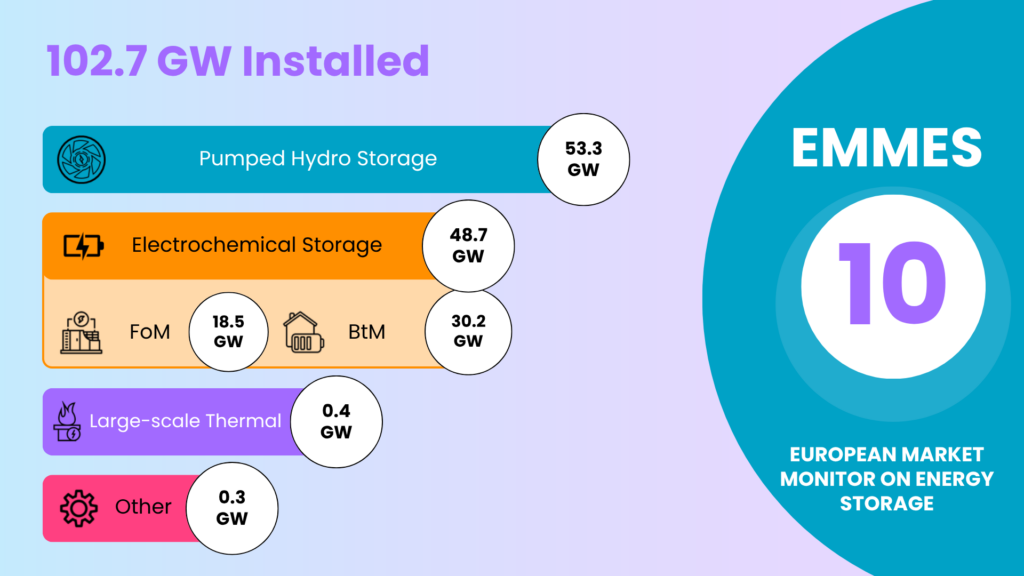
In 2025, Europe surpassed 100 GW of installed storage capacity for the first time, and by Q2 2026 storage overtook nuclear as a source of installed power capacity. With electrochemical storage forecast to grow by a further 153 GW by 2030, energy storage is becoming a core pillar of Europe's future electricity system.
In 2025, Europe surpassed 100 GW of installed storage capacity for the first time, and by Q2 2026 storage overtook nuclear as a source of installed power capacity. With electrochemical storage forecast to grow by a further 153 GW by 2030, energy storage is becoming a core pillar of Europe's future electricity system.
Thermal Energy Storage can help European industry decarbonise, reduce costs, and access new revenue streams. Yet significant regulatory, economic, and financial barriers continue to limit its deployment.
Energy Storage Europe welcomes the proposal for an Industrial Accelerator Act (IAA) and supports its overall objective of strengthening industrial capacity, accelerating decarbonisation, and creating stronger lead markets for strategic clean technologies in the European Union.