In light of interconnected challenges, such as energy security, economic growth, consumer protection, and climate change, energy storage emerges as a crucial tool to address these issues. EASE 2024 manifesto outlines four key goals and corresponding actions that prioritise energy storage, positioning it at the forefront of Europe’s energy system.
March 2024 / Policy Papers
National Energy and Climate Plans
The National Energy and Climate Plans (NECPs) were established under the 2019 Clean Energy Package for Member States to detail how they will meet their 2030 energy and climate targets set by the EU. At the end of June 2023, Member States were due to submit draft updated NECPs to bring Member States in line with more recent EU policies, and the fit for 55 targets. The updated NECPs are meant to include sections on flexibility and energy storage.
EASE has compiled analyses of measures for energy storage in the draft updated NECPs to point out their strengths and weaknesses, based upon the European Commission’s recommendations for Energy Storage. The final document will provide a per-country overview of the recommendations’ implementation in the NECPs, in the context of the Commission’s assessment of the draft plans.
In light of interconnected challenges, such as energy security, economic growth, consumer protection, and climate change, energy storage emerges as a crucial tool to address these issues. EASE 2024 manifesto outlines four key goals and corresponding actions that prioritise energy storage, positioning it at the forefront of Europe’s energy system.
Not a member yet ?
Explore the benefits of joining Energy Storage Europe
Energy Storage Europe welcomes the European Commission's growing focus on cybersecurity in the energy sector and supports the direction of travel across the Cyber Resilience Act (CRA), the Network Code on Cybersecurity, and the proposed Cybersecurity Act (CSA) 2.0. Yet raises concerns that require targeted corrections to ensure these frameworks deliver on their security objectives without inadvertently slowing battery storage deployment.
Energy Storage Europe replies to the European Commission’s public consultation on the Methodology for the Calculation of the recycled content of industrial and EV batteries. Under the Batteries Regulation, several categories of batteries, including industrial batteries, will have to contain a certain percentage of recycled metals to be allowed to be placed on the EU market.
Energy Storage Europe welcomes the proposed revision of the Network Code for generators and the explicit integration of storage, including grid-forming capabilities. Further clarity is needed on requirements for bidirectional storage and the treatment of existing projects.
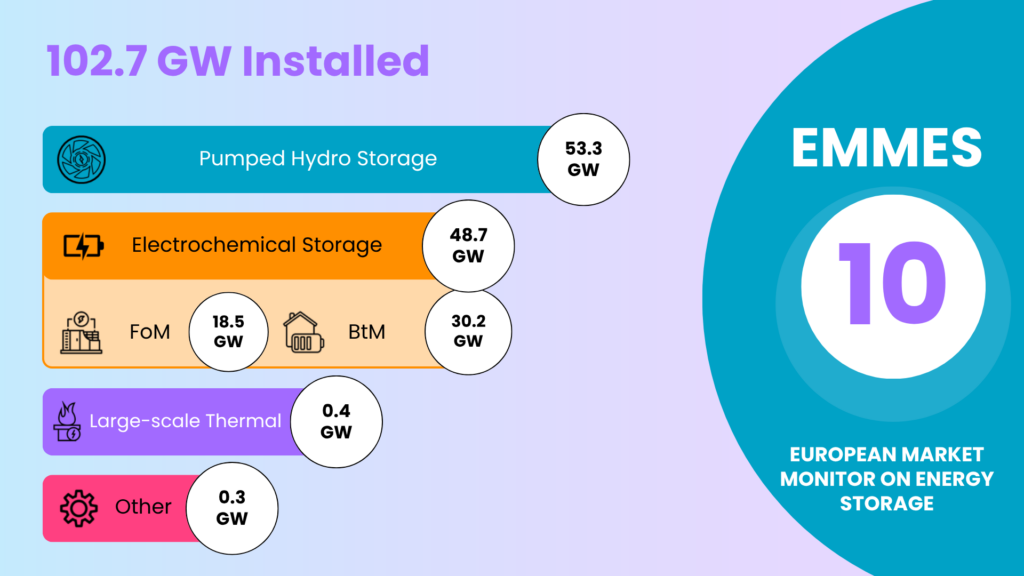
In 2025, Europe surpassed 100 GW of installed storage capacity for the first time, and by Q2 2026 storage overtook nuclear as a source of installed power capacity. With electrochemical storage forecast to grow by a further 153 GW by 2030, energy storage is becoming a core pillar of Europe's future electricity system.