EASE reply to ENTSO-E public consultation on the updated input data and assumptions for the Cost-Benefit Analysis for the definition of a minimum activation time period (Tmin) for Limited Energy Reservoirs (LER) in Continental Europe Synchronous Area.
July 2024 / Policy Papers
Guiding Principles to Develop an EU Methodology to Assess Flexibility Needs
New legal provisions in the energy market design regulation reform have been introduced requiring Member States to carry out an Assessment of Flexibility Needs (AFN) with a 5 to 10-year look-ahead. Therein, MSs will analyse the contribution of various flexibility sources in meeting the defined needs. All Member States will implement the same EU methodology to produce an AFN report and interpret these results to set a non-fossil flexibility target and sub-targets for energy storage and demand response. ENTSOE and EU DSO are assigned the task of developing the methodology.
It is key for stakeholders to be consulted on the methodology's development. This EASE position paper on guiding principles to develop an AFN methodology aims to ensure that energy storage technologies are properly taken into account in the methodology.
EASE reply to ENTSO-E public consultation on the updated input data and assumptions for the Cost-Benefit Analysis for the definition of a minimum activation time period (Tmin) for Limited Energy Reservoirs (LER) in Continental Europe Synchronous Area.
Not a member yet ?
Explore the benefits of joining Energy Storage Europe
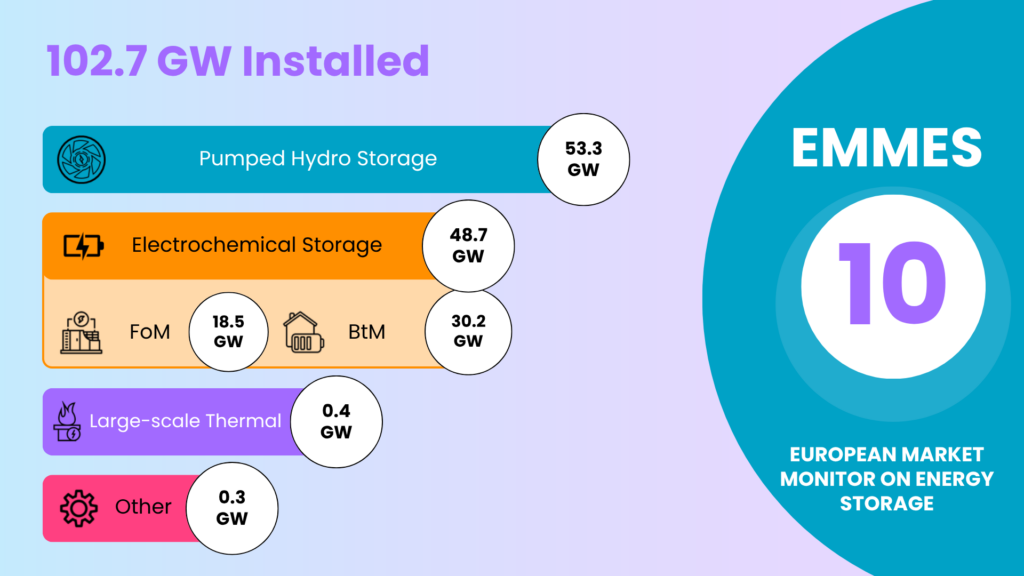
In 2025, Europe surpassed 100 GW of installed storage capacity for the first time, and by Q2 2026 storage overtook nuclear as a source of installed power capacity. With electrochemical storage forecast to grow by a further 153 GW by 2030, energy storage is becoming a core pillar of Europe's future electricity system.
In 2025, Europe surpassed 100 GW of installed storage capacity for the first time, and by Q2 2026 storage overtook nuclear as a source of installed power capacity. With electrochemical storage forecast to grow by a further 153 GW by 2030, energy storage is becoming a core pillar of Europe's future electricity system.
Thermal Energy Storage can help European industry decarbonise, reduce costs, and access new revenue streams. Yet significant regulatory, economic, and financial barriers continue to limit its deployment.
Energy Storage Europe welcomes the proposal for an Industrial Accelerator Act (IAA) and supports its overall objective of strengthening industrial capacity, accelerating decarbonisation, and creating stronger lead markets for strategic clean technologies in the European Union.