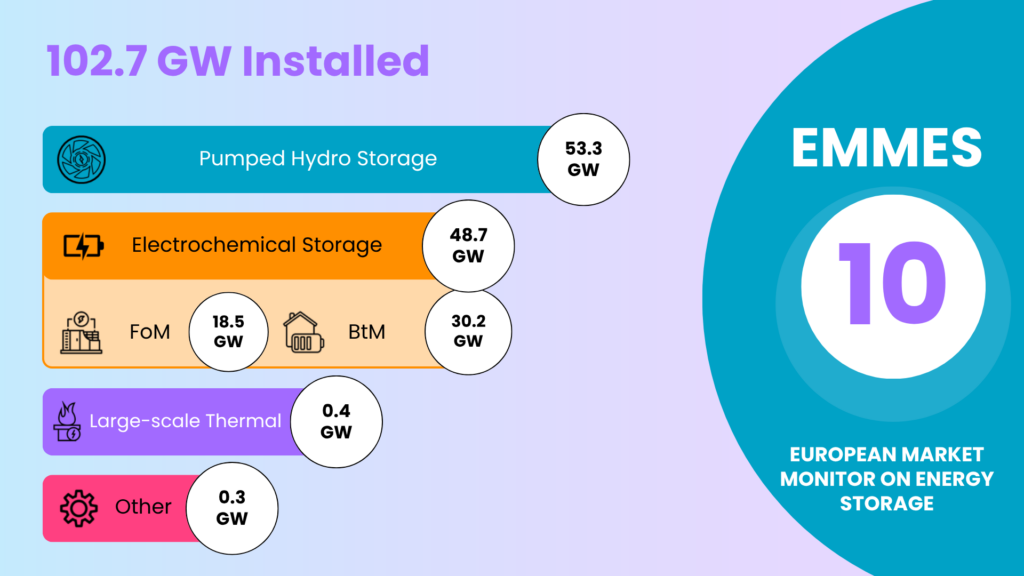
EASE and LCP-Delta are pleased to announce the publication of the eighth edition of the European Market Monitor on Energy Storage (EMMES). The Market Monitor is an interactive database that tracks over 3,000 energy storage projects. With information on assets in over 29 countries, it is the largest and most detailed archive of European storage. The database is accompanied by a report which outlines key EU legislation, drivers and barriers for 14 core countries, future projects and forecasts to 2030.
June 2024 / Policy Papers
Updated Input Data and Assumptions for the Cost-Benefit Analysis for Limited Energy Reservoirs
The update was requested by CE NRAs to consider recent developments in Frequency Containment Reserves costs and CE power system behaviour. The updated inputs will reflect the most recent frequency data, advancements in Limited Energy Reservoir (LER) technology, and changes in the CE power system. This will ensure a more accurate and up-to-date CBA, leading to a more effective Tmin LER definition that can better maintain steady-state frequency during alert states.
EASE has replied to ENTSO-E consultation on the updated input data and assumptions for the Cost-Benefit Analysis for Limited Energy Reservoirs. EASE stands behind these objectives and believes that a more accurate definition of Tmin LER is essential for the efficient, reliable, and cost-effective operation of energy storage systems.
EASE and LCP-Delta are pleased to announce the publication of the eighth edition of the European Market Monitor on Energy Storage (EMMES). The Market Monitor is an interactive database that tracks over 3,000 energy storage projects. With information on assets in over 29 countries, it is the largest and most detailed archive of European storage. The database is accompanied by a report which outlines key EU legislation, drivers and barriers for 14 core countries, future projects and forecasts to 2030.
Not a member yet ?
Explore the benefits of joining Energy Storage Europe
In 2025, Europe surpassed 100 GW of installed storage capacity for the first time, and by Q2 2026 storage overtook nuclear as a source of installed power capacity. With electrochemical storage forecast to grow by a further 153 GW by 2030, energy storage is becoming a core pillar of Europe's future electricity system.
In 2025, Europe surpassed 100 GW of installed storage capacity for the first time, and by Q2 2026 storage overtook nuclear as a source of installed power capacity. With electrochemical storage forecast to grow by a further 153 GW by 2030, energy storage is becoming a core pillar of Europe's future electricity system.
Thermal Energy Storage can help European industry decarbonise, reduce costs, and access new revenue streams. Yet significant regulatory, economic, and financial barriers continue to limit its deployment.
Energy Storage Europe welcomes the proposal for an Industrial Accelerator Act (IAA) and supports its overall objective of strengthening industrial capacity, accelerating decarbonisation, and creating stronger lead markets for strategic clean technologies in the European Union.