On 19 November 2020, EASE has organised an online Roundtable moderated by journalist Sonja Van Renssen focused on large-scale hydrogen deployment across the EU as part of the TSO2020 project.
08.12.2020 / News
Identifying Battery Research Needs for the EU: Batteries Europe Publishes its Strategic Research Agenda
The European Technology and Innovation Platform on Batteries (ETIP Batteries, Batteries Europe) has published its Strategic Research Agenda, one of the central deliverables of the work of the Platform. The document sets the priorities that battery research should follow in the next years, supported by all relevant stakeholders including European, National and Regional R&I funding agencies. EASE is part of the Platform's Secretariat, and its members are involved in the thematic Working Groups and Governing Board, which is chaired by Michael Lippert, Saft.
With the increased efforts towards decarbonisation set by the EU Green Deal and the knowledge that technological progress will lead to progressive electrification, comes the requirement to immediately prioritise battery research, with a holistic approach across the entire battery value chain. Following the Platform's prerogative, the agenda identifies topics across the value chain and the relative urgency in which they need to be tackled in order to foster the energy transition.
Batteries Europe is the one-stop shop for battery research in Europe, coordinating the efforts of research centres and industry in making Europe a competitive, sustainable and self-sufficient actor in the global battery scene. The ETIP is collaborating with related initiatives and associations to disseminate the scope of its work and engage in fruitful synergies in 2021.
On 19 November 2020, EASE has organised an online Roundtable moderated by journalist Sonja Van Renssen focused on large-scale hydrogen deployment across the EU as part of the TSO2020 project.
Energy Storage Europe welcomes the European Commission's growing focus on cybersecurity in the energy sector and supports the direction of travel across the Cyber Resilience Act (CRA), the Network Code on Cybersecurity, and the proposed Cybersecurity Act (CSA) 2.0. Yet raises concerns that require targeted corrections to ensure these frameworks deliver on their security objectives without inadvertently slowing battery storage deployment.
Energy Storage Europe replies to the European Commission’s public consultation on the Methodology for the Calculation of the recycled content of industrial and EV batteries. Under the Batteries Regulation, several categories of batteries, including industrial batteries, will have to contain a certain percentage of recycled metals to be allowed to be placed on the EU market.
Energy Storage Europe welcomes the proposed revision of the Network Code for generators and the explicit integration of storage, including grid-forming capabilities. Further clarity is needed on requirements for bidirectional storage and the treatment of existing projects.
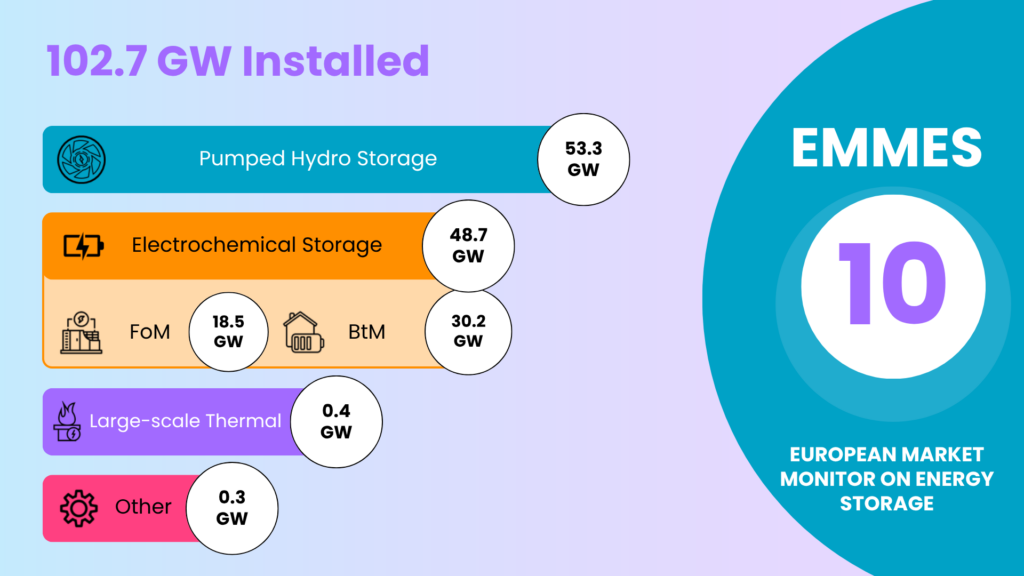
In 2025, Europe surpassed 100 GW of installed storage capacity for the first time, and by Q2 2026 storage overtook nuclear as a source of installed power capacity. With electrochemical storage forecast to grow by a further 153 GW by 2030, energy storage is becoming a core pillar of Europe's future electricity system.