The European Technology and Innovation Platform on Batteries - Batteries Europe has published its Strategic Research Agenda, an essential document by the Platform which aims to steer research priorities for the European battery value chain.
09.12.2020 / News
A Path to Creating a Sustainable, Smart and Resilient Mobility System
Green and digital transitions will drastically reshape the mobility sector. The Commission is putting forward a comprehensive set of measures to put the European Union on the path to creating a sustainable, smart and resilient mobility system.
EASE fully supports the European Commission and believes that greater efforts are needed to deliver the contribution of the transport sector to the 2030 Climate Target Plan and to the European Green Deal. In this sense, energy storage solutions can efficiently support achieving the EU’s targets and a systemic change for the transport sector.
EASE and the Commission’s positions are aligned: the decarbonisation of the transport sector can only be successful in close collaboration with the energy sector and its work on smart electric grids, batteries and production of alternative fuels – hydrogen, biofuels, and synthetic fuels. For all these points, energy storage solutions are key as recognised by the EU Energy System Integration Strategy.
Similarly, EASE also recognises that, if not managed in a smart way, there is a risk that the rapidly increasing fleet of electric vehicles may lead to congestion in the electricity grid. These risks and the related solutions are not fully addressed in the strategy.
For example, the different services that electric vehicles may provide to the electricity systems should be further highlighted. Vehicle-to-grid services, in particular, are key to manage electricity loads across infrastructure assets and time. But they are currently hampered by a.o. energy tariffs and pricing structures, lack of full access to the electricity market, and lack of charging standards/protocols. Some of these topics are mentioned in the Sustainable and Smart Mobility Strategy and Action Plan in different contexts, but not always comprehensively addressed.
Besides, although the need for a recharging/refuelling infrastructure is thoroughly highlighted in the Strategy, the support that energy storage can provide is not aptly investigated. Energy storage systems can charge electricity from the grid at times of low demand and discharge at times of high demand. Such systems increase renewables penetration levels in the transport sector, with minimised curtailment and at optimised system cost. An example: high power fast charging station with battery storage and PV generation. Again, a.o. an evolution of fiscal rules and energy taxes is needed to facilitate the uptake of these solutions and improve access to energy and ancillary markets.
Finally, the Sustainable and Smart Mobility Strategy and the Action Plan are a significant step forward. EASE believes that the foreseen legislative and policy actions can support the greening of the transport sector. Nonetheless, energy storage solutions should be more unreservedly considered to achieve a green, cost-efficient transformation of the mobility and energy system – as already done by the European Commission in the EU Energy System Integration Strategy.
The European Technology and Innovation Platform on Batteries - Batteries Europe has published its Strategic Research Agenda, an essential document by the Platform which aims to steer research priorities for the European battery value chain.
Energy Storage Europe welcomes the European Commission's growing focus on cybersecurity in the energy sector and supports the direction of travel across the Cyber Resilience Act (CRA), the Network Code on Cybersecurity, and the proposed Cybersecurity Act (CSA) 2.0. Yet raises concerns that require targeted corrections to ensure these frameworks deliver on their security objectives without inadvertently slowing battery storage deployment.
Energy Storage Europe replies to the European Commission’s public consultation on the Methodology for the Calculation of the recycled content of industrial and EV batteries. Under the Batteries Regulation, several categories of batteries, including industrial batteries, will have to contain a certain percentage of recycled metals to be allowed to be placed on the EU market.
Energy Storage Europe welcomes the proposed revision of the Network Code for generators and the explicit integration of storage, including grid-forming capabilities. Further clarity is needed on requirements for bidirectional storage and the treatment of existing projects.
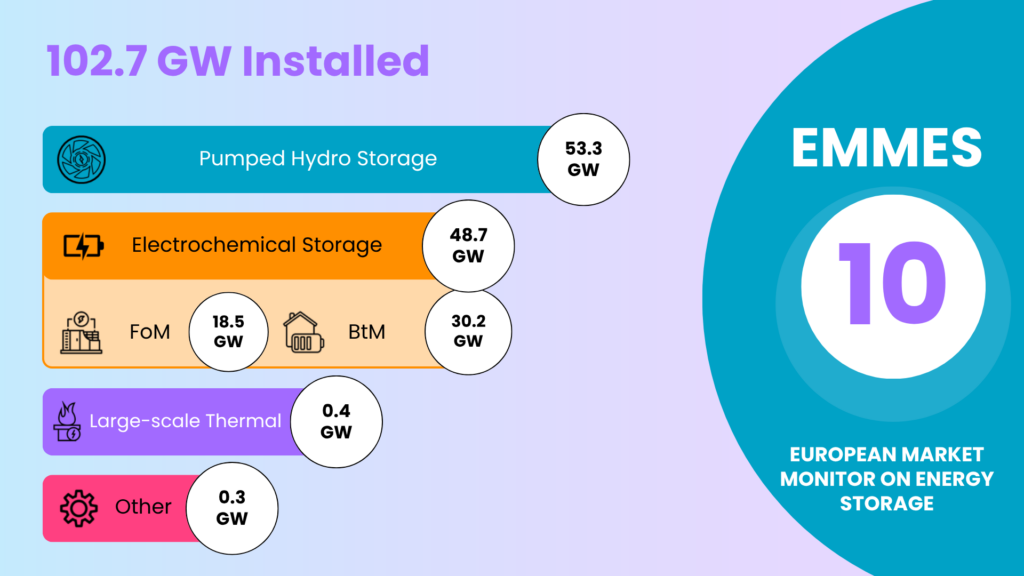
In 2025, Europe surpassed 100 GW of installed storage capacity for the first time, and by Q2 2026 storage overtook nuclear as a source of installed power capacity. With electrochemical storage forecast to grow by a further 153 GW by 2030, energy storage is becoming a core pillar of Europe's future electricity system.