The participation of EASE in EU-funded projects is paramount to foster research, innovation, and deployment of different storage technologies. In 2019 EASE was involved in 10 EU-funded projects, and more are on their way in 2020.
11.02.2020 / News
What to Expect in 2020
2020 promises to be another exciting year for the energy storage industry. EASE will continue to support the development and deployment of innovative storage technologies and to advocate for a fair and future-oriented market design through the work of Working Groups and Task Forces, the advocacy activities and the organiation of the Energy Storage Global Conference.
Implementation of Clean Energy Package and Launch of the European Green Deal
After the formal adoption of Clean Energy Package, the implementation of the new regulations will be still ongoing in 2020. Energy storage is the key element of the energy transition and EASE supports the EU’s ambitious proposals for a European Green Deal with key goal of a net-zero emissions system by 2050. We will advocate for our recommendations and ideas to be taken up by European and national policymakers to ensure energy storage is acknowledged as a central element of the European Green Deal.
Electricity Network Codes and New Regulations on Energy Storage
Since 2018, EASE has participated in the work of Electricity Network Codes expert groups to monitor the necessity for an amendment for the codes for storage and will continue to ensure the representation of the energy storage industry. EASE will also support the ongoing work on preparing new regulations on the sustainability requirements for batteries and in the “smart readiness indicator” for buildings. In addition, EASE will continue to engage in discussions with policymakers and industry to prepare the gas decarbonisation package, expected in 2021.
Horizon Europe and EU Funding
The final proposal for Horizon Europe will be settled in 2020 and the first calls of the new work programme should be launched in 2021. EASE will actively participate in shaping the EU funding framework for energy storage by proposing topics for the Horizon Europe Work Programme 2021-2022 to ensure support for the development and deployment of energy storage technologies. EASE will also continue its work on ongoing EU-funded projects focused on energy storage and work on expanding financing opportunities for storage.
Energy Storage Global Conference
2020 will be the year of EASE Energy Storage Global Conference which will take place from 13-15 October 2020. The 3-day Conference will reflect the pressing issues and trends in the energy storage industry and will feature more than 80 speakers. Over 400 participants are expected to join and they will be as diverse as the speakers: leading energy storage experts from industry and research, EU policymakers, investors and other stakeholders keen on learning more about this ex-citing sector.
The EASE Secretariat looks forward to a successful 2020 working together with all of the EASE members and our many partners in Europe to further promote and strengthen energy storage.
If you wish to be involved in EASE activities discover more about the membership optionsor contact Ms Doriana Forleo.
The participation of EASE in EU-funded projects is paramount to foster research, innovation, and deployment of different storage technologies. In 2019 EASE was involved in 10 EU-funded projects, and more are on their way in 2020.
Energy Storage Europe welcomes the European Commission's growing focus on cybersecurity in the energy sector and supports the direction of travel across the Cyber Resilience Act (CRA), the Network Code on Cybersecurity, and the proposed Cybersecurity Act (CSA) 2.0. Yet raises concerns that require targeted corrections to ensure these frameworks deliver on their security objectives without inadvertently slowing battery storage deployment.
Energy Storage Europe replies to the European Commission’s public consultation on the Methodology for the Calculation of the recycled content of industrial and EV batteries. Under the Batteries Regulation, several categories of batteries, including industrial batteries, will have to contain a certain percentage of recycled metals to be allowed to be placed on the EU market.
Energy Storage Europe welcomes the proposed revision of the Network Code for generators and the explicit integration of storage, including grid-forming capabilities. Further clarity is needed on requirements for bidirectional storage and the treatment of existing projects.
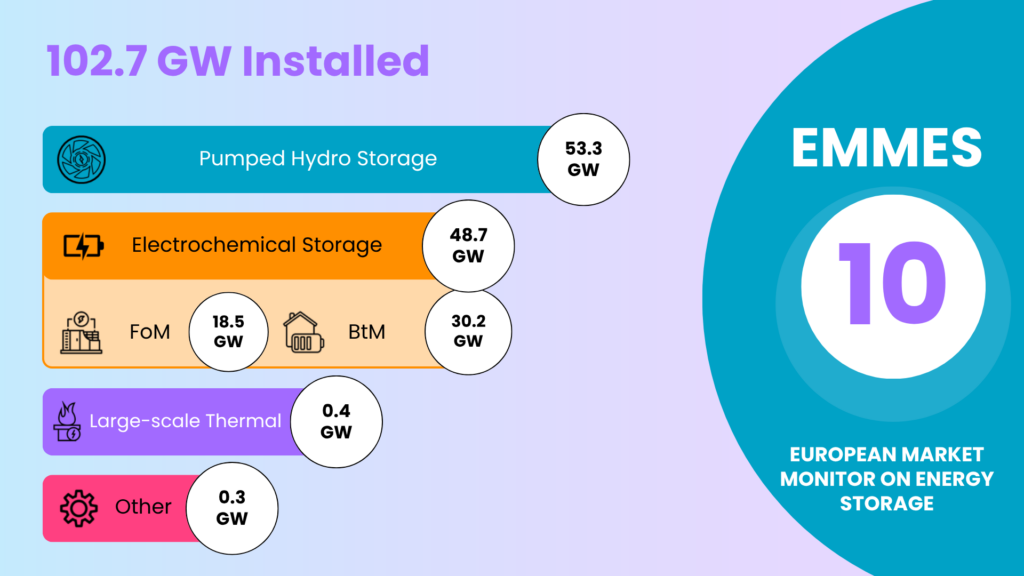
In 2025, Europe surpassed 100 GW of installed storage capacity for the first time, and by Q2 2026 storage overtook nuclear as a source of installed power capacity. With electrochemical storage forecast to grow by a further 153 GW by 2030, energy storage is becoming a core pillar of Europe's future electricity system.