EASE has prepared an analysis that aims to shed light on the numerous benefits of thermal energy storage (TES) by providing an overview of technologies, inspiring projects, business cases, and revenue streams. Policy recommendations are also discussed.
October 2023 / Reports and Studies
Business Case and Taxonomy of Behind-the-Meter Battery Energy Storage Systems in Europe
Behind-the-meter (BtM) Battery Energy Storage Systems (BESS) are pivotal in the European Union's pursuit of ambitious climate goals and renewable energy integration. Co-located with technologies like solar photovoltaics (PV), they empower consumers and contribute to peak-shaving and load management. However, realizing their full potential necessitates a clear regulatory framework.
As BtM BESS deployment continues to expand, addressing existing barriers is imperative. These challenges include among others fair remuneration, net metering, complex tax structures, and inadequate integration of energy storage in system planning.
By addressing these challenges and providing the necessary policy support, the European Union can fully leverage BtM BESS and BtM BESS+PV solutions. This approach not only promotes a sustainable and resilient energy system but also empowers consumers to actively participate in the energy transition.
EASE has prepared an analysis that aims to shed light on the numerous benefits of thermal energy storage (TES) by providing an overview of technologies, inspiring projects, business cases, and revenue streams. Policy recommendations are also discussed.
Not a member yet ?
Explore the benefits of joining Energy Storage Europe
Energy Storage Europe replies to the European Commission’s public consultation on the Methodology for the Calculation of the recycled content of industrial and EV batteries. Under the Batteries Regulation, several categories of batteries, including industrial batteries, will have to contain a certain percentage of recycled metals to be allowed to be placed on the EU market.
Energy Storage Europe welcomes the proposed revision of the Network Code for generators and the explicit integration of storage, including grid-forming capabilities. Further clarity is needed on requirements for bidirectional storage and the treatment of existing projects.
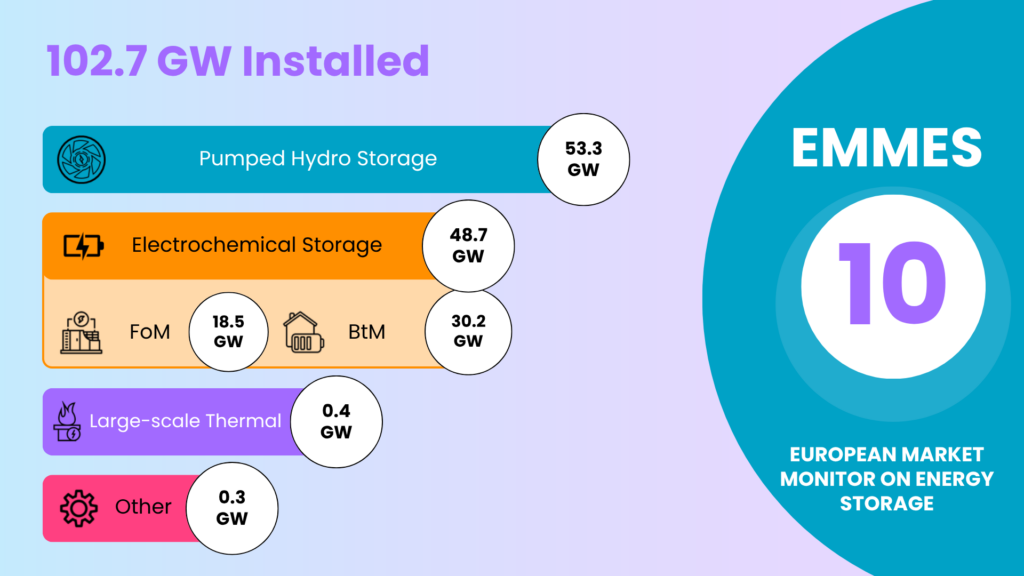
In 2025, Europe surpassed 100 GW of installed storage capacity for the first time, and by Q2 2026 storage overtook nuclear as a source of installed power capacity. With electrochemical storage forecast to grow by a further 153 GW by 2030, energy storage is becoming a core pillar of Europe's future electricity system.
In 2025, Europe surpassed 100 GW of installed storage capacity for the first time, and by Q2 2026 storage overtook nuclear as a source of installed power capacity. With electrochemical storage forecast to grow by a further 153 GW by 2030, energy storage is becoming a core pillar of Europe's future electricity system.