The Energy Storage Europe Association Guidelines on Safety Best Practices for Battery Energy Storage Systems (BESS) are designed to support the safe deployment of outdoor, utility-scale lithium-ion (Li-ion) BESS across Europe. These guidelines aim to assist developers, manufacturers, service providers, and all stakeholders in the value chain—including relevant authorities, first responders, and permitting bodies—in implementing safety practices that align with regulatory requirements and technical standards.
May 2025 / Policy Papers
Suggested Amendments to the Clean Industrial State Aid Framework
Energy Storage Europe Association has prepared a position paper with suggested amendments to the Draft Clean Industrial State Aid Framework (CISAF), initially submitted as a response to the Public Consultation to the Commission seeking the views of relevant stakeholders on a draft for this framework.
The CISAFwill guideMember States on designing State aid measures in support of the objectives of the Clean Industrial Deal. This framework builds on the experience gained through the transition provisions of the Temporary Crisis and Transition Framework (TCTF). Once adopted, the CISAF will replace the TCTF. It is intended to remain in force until 31 December 2030, ensuring a stable and predictable environment for public support. The draft CISAF includes provisions for aid measures that accelerate the rollout of renewable energy, facilitate industrial decarbonisation, ensure sufficient manufacturing capacity in clean technologies, and de-risk private investment in the green transition.
Energy Storage Europe Association welcomes CISAF and its efforts to align EU State aid rules with the objectives of the Clean Industrial Deal towards a decarbonised and competitive industry in Europe. In this context, energy storage is essential for renewable energy integration and to provide decarbonisation solutions to energy-intensive industries.
The Energy Storage Europe Association Guidelines on Safety Best Practices for Battery Energy Storage Systems (BESS) are designed to support the safe deployment of outdoor, utility-scale lithium-ion (Li-ion) BESS across Europe. These guidelines aim to assist developers, manufacturers, service providers, and all stakeholders in the value chain—including relevant authorities, first responders, and permitting bodies—in implementing safety practices that align with regulatory requirements and technical standards.
Not a member yet ?
Explore the benefits of joining Energy Storage Europe
Energy Storage Europe replies to the European Commission’s public consultation on the Methodology for the Calculation of the recycled content of industrial and EV batteries. Under the Batteries Regulation, several categories of batteries, including industrial batteries, will have to contain a certain percentage of recycled metals to be allowed to be placed on the EU market.
Energy Storage Europe welcomes the proposed revision of the Network Code for generators and the explicit integration of storage, including grid-forming capabilities. Further clarity is needed on requirements for bidirectional storage and the treatment of existing projects.
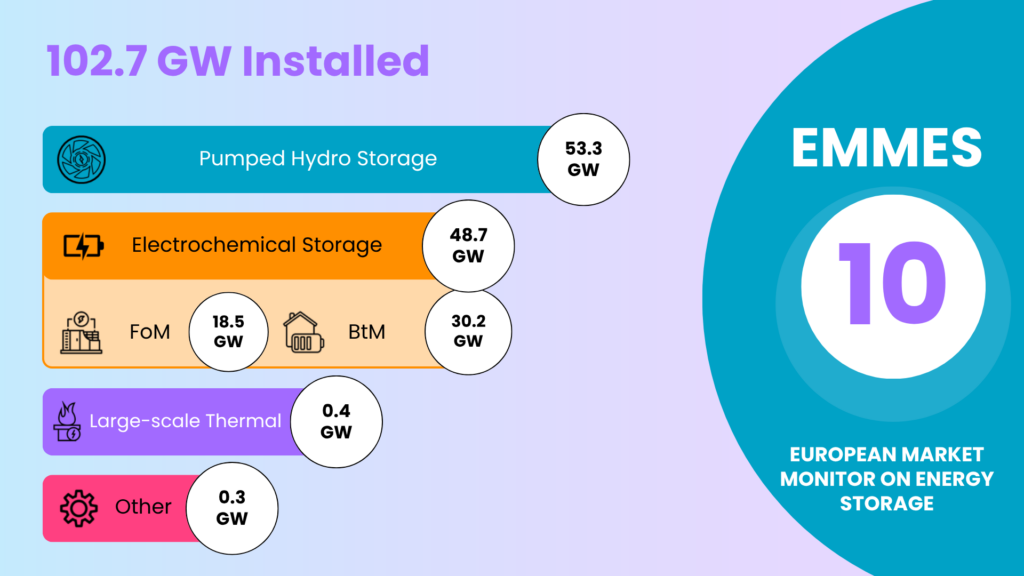
In 2025, Europe surpassed 100 GW of installed storage capacity for the first time, and by Q2 2026 storage overtook nuclear as a source of installed power capacity. With electrochemical storage forecast to grow by a further 153 GW by 2030, energy storage is becoming a core pillar of Europe's future electricity system.
In 2025, Europe surpassed 100 GW of installed storage capacity for the first time, and by Q2 2026 storage overtook nuclear as a source of installed power capacity. With electrochemical storage forecast to grow by a further 153 GW by 2030, energy storage is becoming a core pillar of Europe's future electricity system.