Energy Storage Europe Association responds to the European Commission’s Public Consultation on the European Grids Package, calling for clearer guidance and obligations on flexibility assessments in planning processes. This includes common methodologies, improved DSO-TSO coordination, and enhanced grid connection procedures. Storage should be considered a standard resource for grid services and reflected accordingly in system planning, cost-benefit analyses, and network development scenarios.
November 2025 / Market Analyses
EMMES 9.5 - November 2025
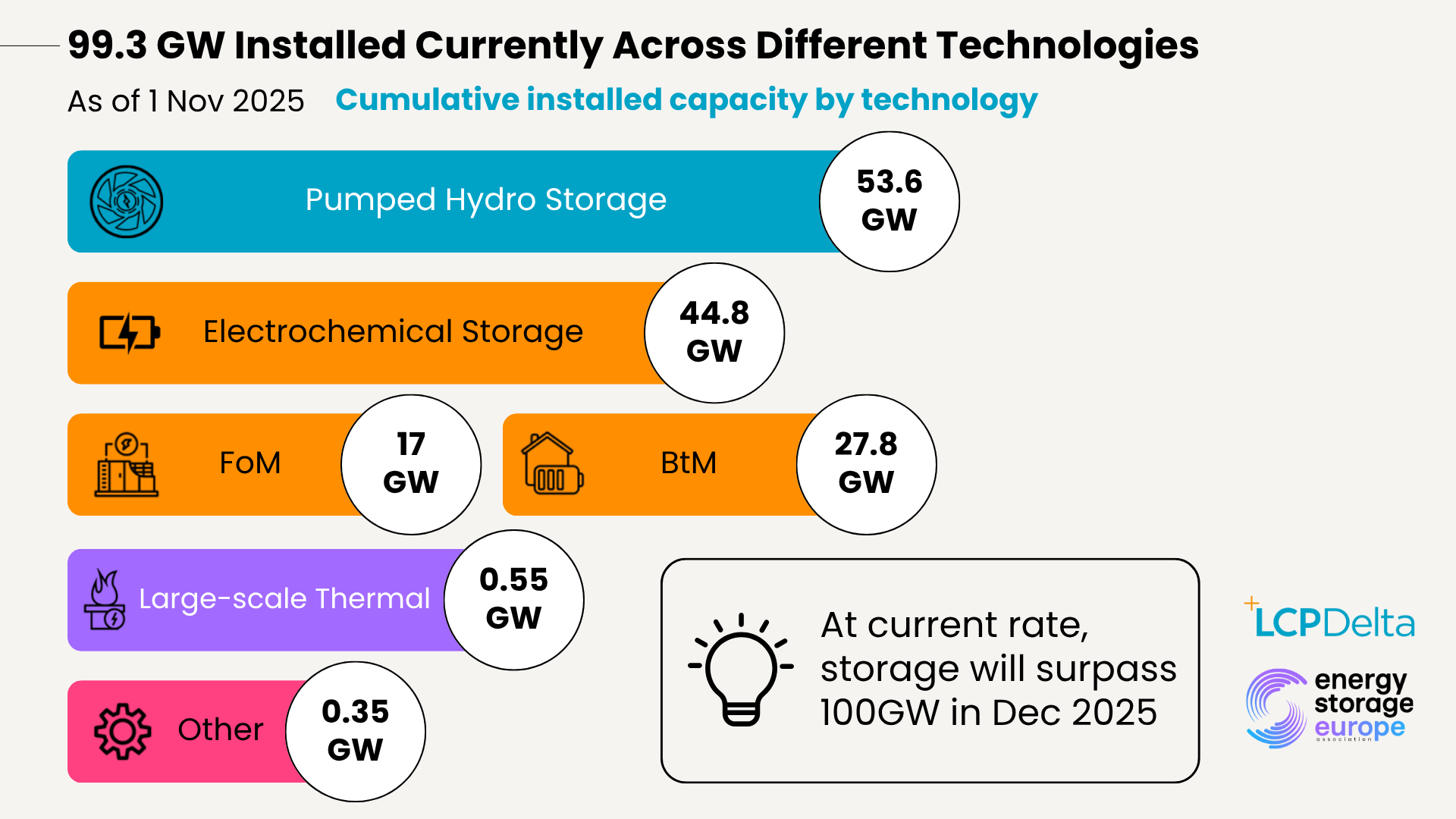
Europe set to hit 100 GW of energy storage, with more than 115% growth expected by 2030.
The 9.5 edition of the European Market Monitor on Energy Storage (EMMES) by the Energy Storage Europe Association and LCP Delta, is now available. The EU, UK, Norway, and Switzerland together are expected to reach 100 GW of installed energy storage in November 2025. This milestone represents enough capacity to meet the peak electricity demand of Germany and the Netherlands. With storage capacity forecast to grow by a further 115% by 2030, this will play a crucial role in Europe’s energy transition, creating more space for renewables on the grid.
LCP Delta and Energy Storage Europe believe the energy storage industry is only just getting started and will continue to make a substantial contribution to Europe’s energy transition. They expect the following:
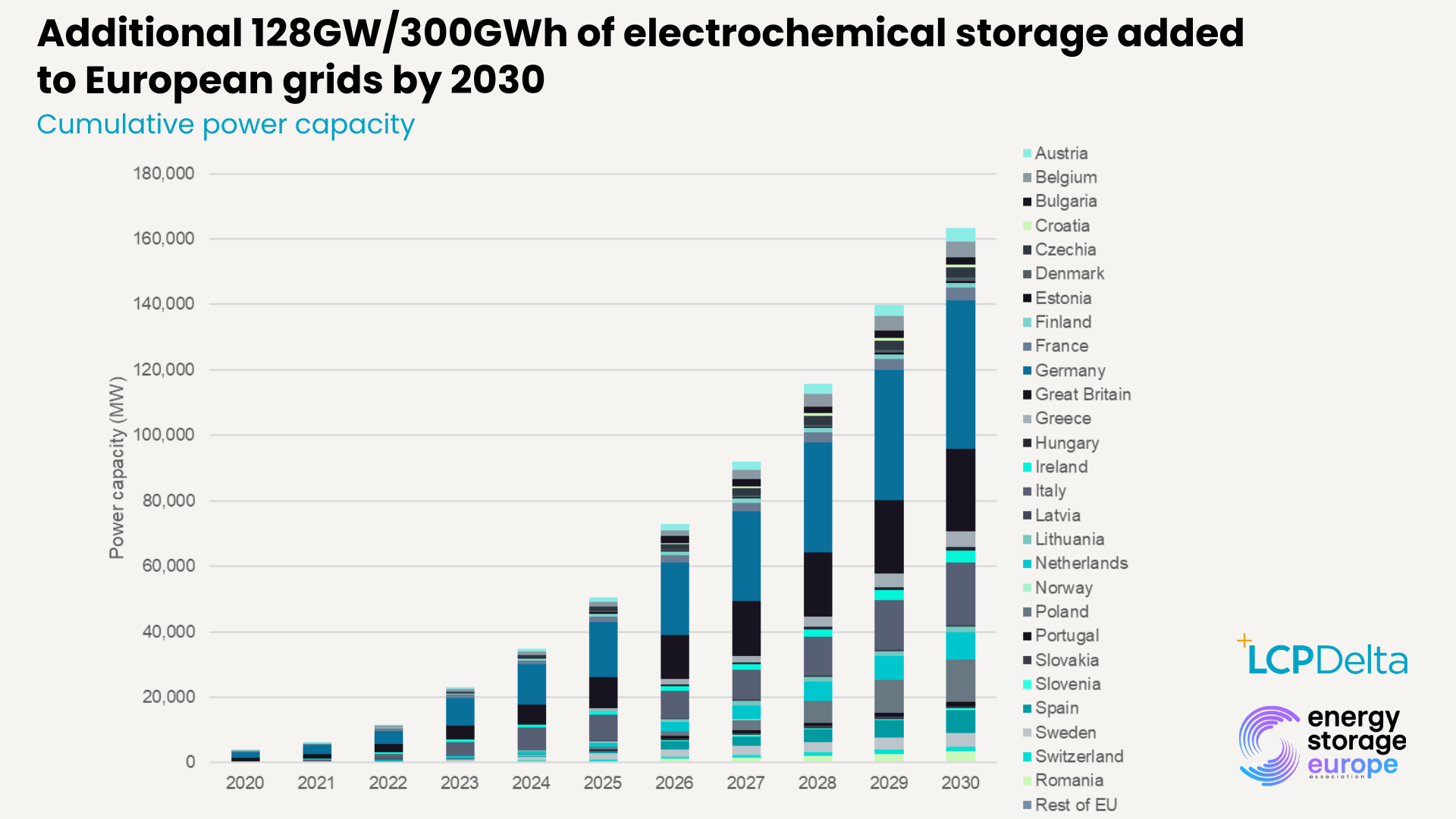
Energy storage will reach beyond 215 GW by 2030 – with battery storage alone exceeding 160 GW.
By the end of the decade, storage will be deployed at a rate of 20-25GW per year, which is more than 20 times the rate of installation in the 2020s.
Utility-scale energy storage to see strong growth, supported by improving economics, targeted auctions, and other support schemes across countries.
Residential battery sales are expected to recover from 2027, supported by a rebounding PV market, rising electrification of homes and transport, dynamic tariffs, and new financing models.
C&I storage to become increasingly mainstream, with policy, revenue streams, grid rules, and tariffs shaping deployment.
To download the "EMMES 9.5 Report", please enter your information below. The file will then be sent to you by email.
Energy Storage Europe Association responds to the European Commission’s Public Consultation on the European Grids Package, calling for clearer guidance and obligations on flexibility assessments in planning processes. This includes common methodologies, improved DSO-TSO coordination, and enhanced grid connection procedures. Storage should be considered a standard resource for grid services and reflected accordingly in system planning, cost-benefit analyses, and network development scenarios.
Not a member yet ?
Explore the benefits of joining Energy Storage Europe
Energy Storage Europe welcomes the European Commission's growing focus on cybersecurity in the energy sector and supports the direction of travel across the Cyber Resilience Act (CRA), the Network Code on Cybersecurity, and the proposed Cybersecurity Act (CSA) 2.0. Yet raises concerns that require targeted corrections to ensure these frameworks deliver on their security objectives without inadvertently slowing battery storage deployment.
Energy Storage Europe replies to the European Commission’s public consultation on the Methodology for the Calculation of the recycled content of industrial and EV batteries. Under the Batteries Regulation, several categories of batteries, including industrial batteries, will have to contain a certain percentage of recycled metals to be allowed to be placed on the EU market.
Energy Storage Europe welcomes the proposed revision of the Network Code for generators and the explicit integration of storage, including grid-forming capabilities. Further clarity is needed on requirements for bidirectional storage and the treatment of existing projects.