The European Commission has recently launched a stakeholder consultation on its upcoming guidance regarding grid connections in situations where capacity constraints exist. In response, Energy Storage Europe Association urged reforms to tackle stalled “ghost” projects blocking viable energy storage. Key recommendations include a “first-ready, first-served” model, transparent grid data, and more flexible rules to accelerate the clean energy transition.
August 2025 / Consultations & Advocacy
Reply to Public Consultation on European Grids Package
Energy Storage Europe Association welcomes the European Commission’s efforts to modernise the EU grid regulatory framework through the European Grids Package. As Europe moves toward an increasingly decentralised, electrified, and decarbonised energy system, the role of flexibility - particularly energy storage - must be central in both policy and grid planning. While the regulatory framework has evolved, significant gaps remain in how flexibility needs are systematically assessed, planned for, and integrated across both transmission and distribution levels.
Despite recent initiatives, the current framework is not yet sufficient to ensure that flexibility - including demand response, storage, and digital grid solutions - is fully considered as an alternative or complement to traditional grid reinforcements. National and EU-level network development plans often lack requirements to assess flexibility options or to compare their costs and benefits against conventional investments. Storage continues to be undervalued and underutilised, even though it can deliver congestion relief, balancing, and grid deferral services with greater speed and lower environmental impact.
Energy Storage Systems (ESS) are versatile assets capable of delivering multiple grid services from a single installation. Beyond demand shifting and renewable integration, ESS can provide synthetic inertia via grid-forming inverters, voltage control, and black start capabilities - functions traditionally covered by separate assets like synchronous condensers. To ensure a cost-effective and resilient grid, TSOs should be encouraged to fully consider the multi-service capabilities of ESS. Policy guidance may be needed to address existing biases toward conventional assets and to support the validation and integration of battery-based solutions for grid stability.
To close these gaps, Energy Storage Europe Association calls for clearer guidance and obligations on flexibility assessments in planning processes, with common methodologies and better DSO-TSO coordination and better grid connection procedures as well. Storage should be considered as a standard resource for grid services, and be reflected accordingly in system planning, cost-benefit analysis, and network development scenarios.
The European Commission has recently launched a stakeholder consultation on its upcoming guidance regarding grid connections in situations where capacity constraints exist. In response, Energy Storage Europe Association urged reforms to tackle stalled “ghost” projects blocking viable energy storage. Key recommendations include a “first-ready, first-served” model, transparent grid data, and more flexible rules to accelerate the clean energy transition.
Not a member yet ?
Explore the benefits of joining Energy Storage Europe
Energy Storage Europe replies to the European Commission’s public consultation on the Methodology for the Calculation of the recycled content of industrial and EV batteries. Under the Batteries Regulation, several categories of batteries, including industrial batteries, will have to contain a certain percentage of recycled metals to be allowed to be placed on the EU market.
Energy Storage Europe welcomes the proposed revision of the Network Code for generators and the explicit integration of storage, including grid-forming capabilities. Further clarity is needed on requirements for bidirectional storage and the treatment of existing projects.
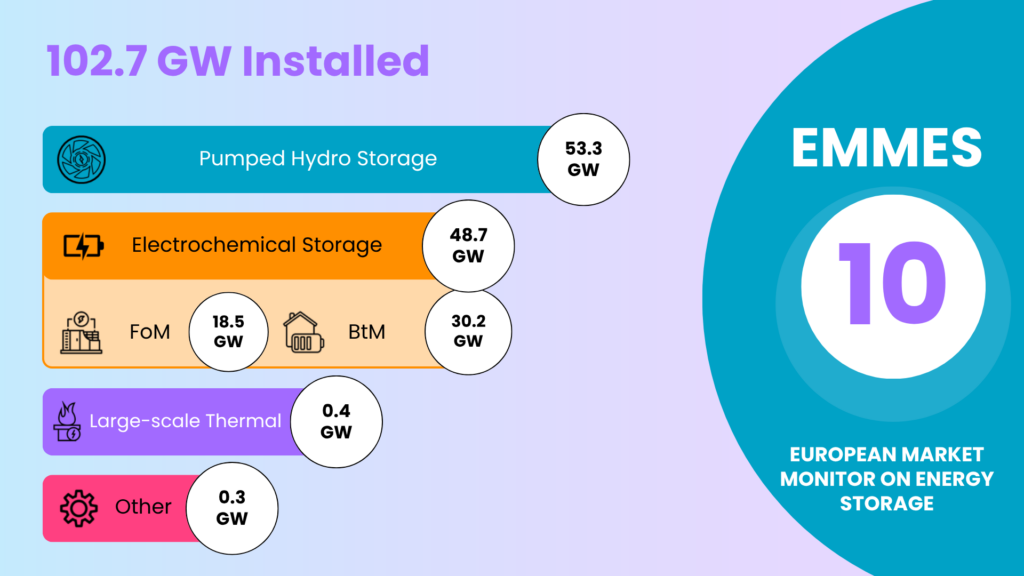
In 2025, Europe surpassed 100 GW of installed storage capacity for the first time, and by Q2 2026 storage overtook nuclear as a source of installed power capacity. With electrochemical storage forecast to grow by a further 153 GW by 2030, energy storage is becoming a core pillar of Europe's future electricity system.
In 2025, Europe surpassed 100 GW of installed storage capacity for the first time, and by Q2 2026 storage overtook nuclear as a source of installed power capacity. With electrochemical storage forecast to grow by a further 153 GW by 2030, energy storage is becoming a core pillar of Europe's future electricity system.