EASE has prepared a position paper on the Renewable Energy Directive Revision (REDIII) highlighting the great opportunity this review offers in terms of speeding up decarbonisation efforts in the energy system. EASE believes energy storage can be fostered through RED III in multiple ways.
April 2022 / Policy Papers
Optimising Energy Use: How Energy Storage Can Support European Energy Reduction Needs
EASE welcomes these revisions as an opportunity to speed up decarbonisation efforts through the efficient and optimised use of energy. However, stronger integration of energy storage solutions is required.
These are the necessary steps to be urgently taken to favour faster emission reduction over the next decade:
Optimising energy in buildings: Capture the benefits of building renovation to optimise energy consumption alongside the installation of renewable energy sources and energy storage, in addition to energy efficiency interventions. To maximise the benefits, the role of energy storage shall be considered when calculating the building's energy performance;
Buildings as active participants in the energy system: Buildings could play an important role in the increasingly electrified future energy system, by providing flexibility to the system and empowering consumers. In this regard, all necessary assets to reduce and make flexible building consumption must be deployed and monitored through the use of the Smart Readiness Indicator (SRI) and the installation of energy storage solutions;
System integration to support an energy efficient system: Connecting the building, transportation, and energy sectors is critical to promote system efficiency. When combined with charging points, RES and heating and cooling applications, energy storage solutions directly support this integration by providing additional flexibility to the electricity grid.
EASE has prepared a position paper on the Renewable Energy Directive Revision (REDIII) highlighting the great opportunity this review offers in terms of speeding up decarbonisation efforts in the energy system. EASE believes energy storage can be fostered through RED III in multiple ways.
Not a member yet ?
Explore the benefits of joining Energy Storage Europe
Energy Storage Europe replies to the European Commission’s public consultation on the Methodology for the Calculation of the recycled content of industrial and EV batteries. Under the Batteries Regulation, several categories of batteries, including industrial batteries, will have to contain a certain percentage of recycled metals to be allowed to be placed on the EU market.
Energy Storage Europe welcomes the proposed revision of the Network Code for generators and the explicit integration of storage, including grid-forming capabilities. Further clarity is needed on requirements for bidirectional storage and the treatment of existing projects.
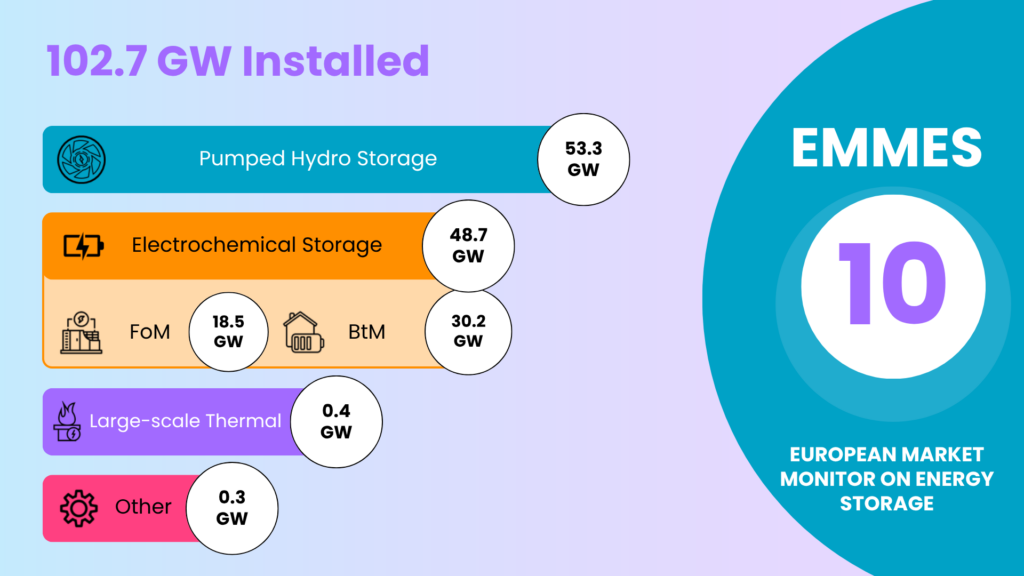
In 2025, Europe surpassed 100 GW of installed storage capacity for the first time, and by Q2 2026 storage overtook nuclear as a source of installed power capacity. With electrochemical storage forecast to grow by a further 153 GW by 2030, energy storage is becoming a core pillar of Europe's future electricity system.
In 2025, Europe surpassed 100 GW of installed storage capacity for the first time, and by Q2 2026 storage overtook nuclear as a source of installed power capacity. With electrochemical storage forecast to grow by a further 153 GW by 2030, energy storage is becoming a core pillar of Europe's future electricity system.