EASE has prepared a short summary on one of the following energy storage application groups - Ancillary Services.
November 2021 / Reports and Studies
Services to Support Distribution Infrastructure
The Task Force on Segmentation of Applications has developed the Services to Support Distribution Infrastructure Report, among other application descriptions. This work builds on the Summary of Energy Storage Applications published in June 2020.
This overview provides a summary of different energy storage applications that can provide alternative or traditional grid infrastructures at the distribution level. As the variable renewable energy sources are deployed regularly, these emerging services are gaining importance on the EU Market.
Services to Distribution Infrastructure are composed of six key systems:
Distribution Grid Upgrade Deferral: using energy storage to defer or avoid distribution infrastructure upgrades and solve distribution congestion issues by installing energy storage systems instead of new lines; using energy storage as a distribution grid component to decrease the traditional grid size during the grid planning process by basing its design on a medium power value and not a peak power value.
Contingency Grid Support: using energy storage to perform some capacity/voltage support in order to reduce the impacts of the loss of a major grid component. It refers to redundancy provisions to cover the trip of the largest transmission line in an area.
Dynamic Local Voltage Control: using energy storage to maintain the voltage profile within admissible contractual/regulatory limits.
Intentional Islanding: using energy storage to energise a non-loopable feeder during an outage.
Reactive Power Compensation: using energy storage to reduce the amount of reactive energy drawn from transmission and charged by the TSO to the DSO.
Cross Sectoral Storage: the practice of coupling the electricity sector with other energy sectors (gas, fuel, heat) by converting excess supply of electricity to the grid into energy carriers, synthetic fuels, and heat, thus avoiding curtailment of running power generators (RES, thermal power plants, etc.).
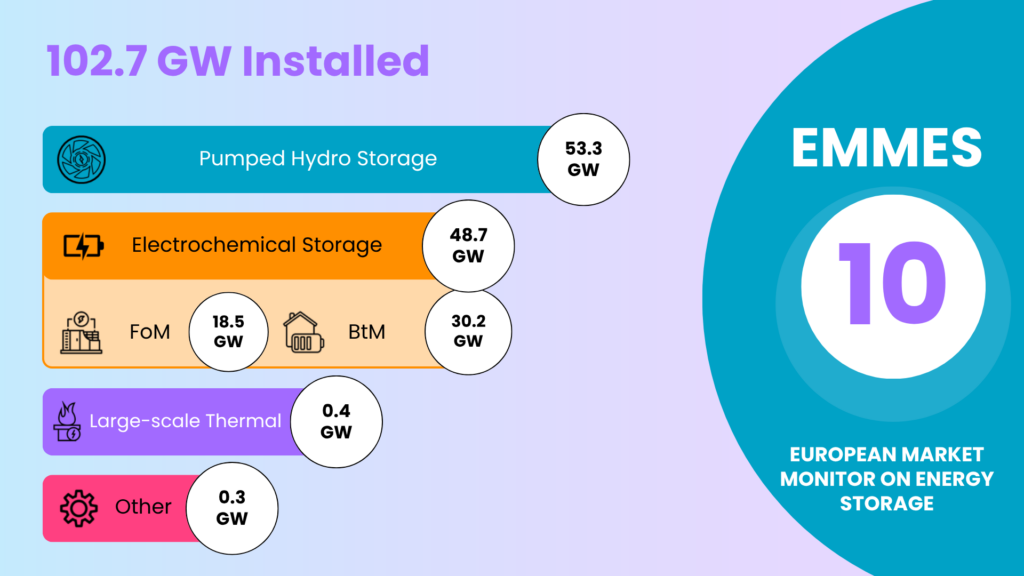
In 2025, Europe surpassed 100 GW of installed storage capacity for the first time, and by Q2 2026 storage overtook nuclear as a source of installed power capacity. With electrochemical storage forecast to grow by a further 153 GW by 2030, energy storage is becoming a core pillar of Europe's future electricity system.
In 2025, Europe surpassed 100 GW of installed storage capacity for the first time, and by Q2 2026 storage overtook nuclear as a source of installed power capacity. With electrochemical storage forecast to grow by a further 153 GW by 2030, energy storage is becoming a core pillar of Europe's future electricity system.
Thermal Energy Storage can help European industry decarbonise, reduce costs, and access new revenue streams. Yet significant regulatory, economic, and financial barriers continue to limit its deployment.
Energy Storage Europe welcomes the proposal for an Industrial Accelerator Act (IAA) and supports its overall objective of strengthening industrial capacity, accelerating decarbonisation, and creating stronger lead markets for strategic clean technologies in the European Union.