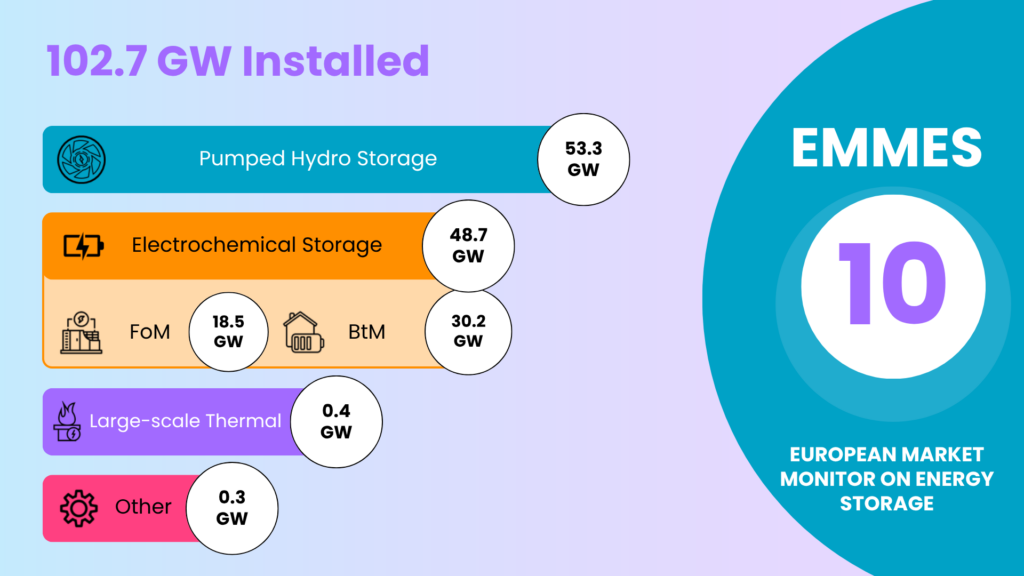
The Market Monitor is based on the most extensive database of European energy storage projects. The database of over 2,600 projects includes detailed data on current installations by customer segment (residential, C&I and front-of-meter) across 24 European countries, future projects and forecasts to 2030. The database is accompanied by a report which outlines key EU legislation, drivers and barriers for 12 core countries.
June 2022 / Reports and Studies
Local Flexibility at DSO Level and the Multi-service Business Case of Energy Storage
The EASE Task Force on Multi-services Business Cases for Energy Storage has prepared a report looking at the key role of energy storage as a Local Flexibility provider. This paper gives an overview of existing short-term local flexibility schemes in Europe today including Active-network management (ANM) and other flexibility services and their implications on the business case for energy storage. However, flexibility markets in operation today are not compatible with the provision of multiple services, hindering the business case of energy storage. This report highlights possible options for their evolution and key market design questions. Such flexibility services must be designed and tendered in such a way that they allow for a level playing field for various flexibility options. An adequate Flexibility market design would enable the monetisation of flexibility provided by storage when acting as both demand and generation, allowing it to be stackable with other services.
EASE makes the following recommendations for the design of flexibility options:
Monitor the implementation of article 32 of EU 2019/944 across Europe.
Development of Standardised Flexibility Services markets based on capacity payments. Ideally these markets should enable contracting peak demand, congestion, voltage and stability products and should be compatible with zero carbon ambitions. Contractual frameworks should provide revenue certainty for solutions that require the development of physical assets. This would promote investability.
Development of harmonised common principles to be integrated in assessment methodologies used to compare the cost and benefits of various Network options, e.g. ANM (grid flexibilities, flexibility connection), Flexibility Services and Network Reinforcement. Promote collaboration with key stakeholders in an open and transparent way.
Enabling the trading of curtailment in the case of flexible connections and foster the creation of platforms to exchange energy in case of network congestion.
The Market Monitor is based on the most extensive database of European energy storage projects. The database of over 2,600 projects includes detailed data on current installations by customer segment (residential, C&I and front-of-meter) across 24 European countries, future projects and forecasts to 2030. The database is accompanied by a report which outlines key EU legislation, drivers and barriers for 12 core countries.
Not a member yet ?
Explore the benefits of joining Energy Storage Europe
Energy Storage Europe welcomes the European Commission's growing focus on cybersecurity in the energy sector and supports the direction of travel across the Cyber Resilience Act (CRA), the Network Code on Cybersecurity, and the proposed Cybersecurity Act (CSA) 2.0. Yet raises concerns that require targeted corrections to ensure these frameworks deliver on their security objectives without inadvertently slowing battery storage deployment.
Energy Storage Europe replies to the European Commission’s public consultation on the Methodology for the Calculation of the recycled content of industrial and EV batteries. Under the Batteries Regulation, several categories of batteries, including industrial batteries, will have to contain a certain percentage of recycled metals to be allowed to be placed on the EU market.
Energy Storage Europe welcomes the proposed revision of the Network Code for generators and the explicit integration of storage, including grid-forming capabilities. Further clarity is needed on requirements for bidirectional storage and the treatment of existing projects.
In 2025, Europe surpassed 100 GW of installed storage capacity for the first time, and by Q2 2026 storage overtook nuclear as a source of installed power capacity. With electrochemical storage forecast to grow by a further 153 GW by 2030, energy storage is becoming a core pillar of Europe's future electricity system.