EASE has published an extensive review study for estimating Energy Storage Targets for 2030 and 2050which will drive thenecessary boost in storage deployment urgently needed today. Current market trajectories for storage deployment are significantly underestimating the system needs for energy storage. If we continue at historic deployment rates Europe will not be able to integrate the rapidly growing renewables and will fall short of its 2030 and 2050 climate targets.
June 2022 / Market Analyses
EMMES 6.0 - JUNE 2022
EASE and Delta-EE are pleased to announce the publication of the sixth edition of the European Market Monitor on Energy Storage (EMMES).
The Market Monitor is based on the most extensive database of European energy storage projects. The database of over 2,600 projects includes detailed data on current installations by customer segment (residential, C&I and front-of-meter) across 24 European countries, future projects and forecasts to 2030. The database is accompanied by a report which outlines key EU legislation, drivers and barriers for 12 core countries. The focus of the report is on electrochemical storage but the database includes other technologies, e.g pumped hydro.
EMMES 6 key takeaways:
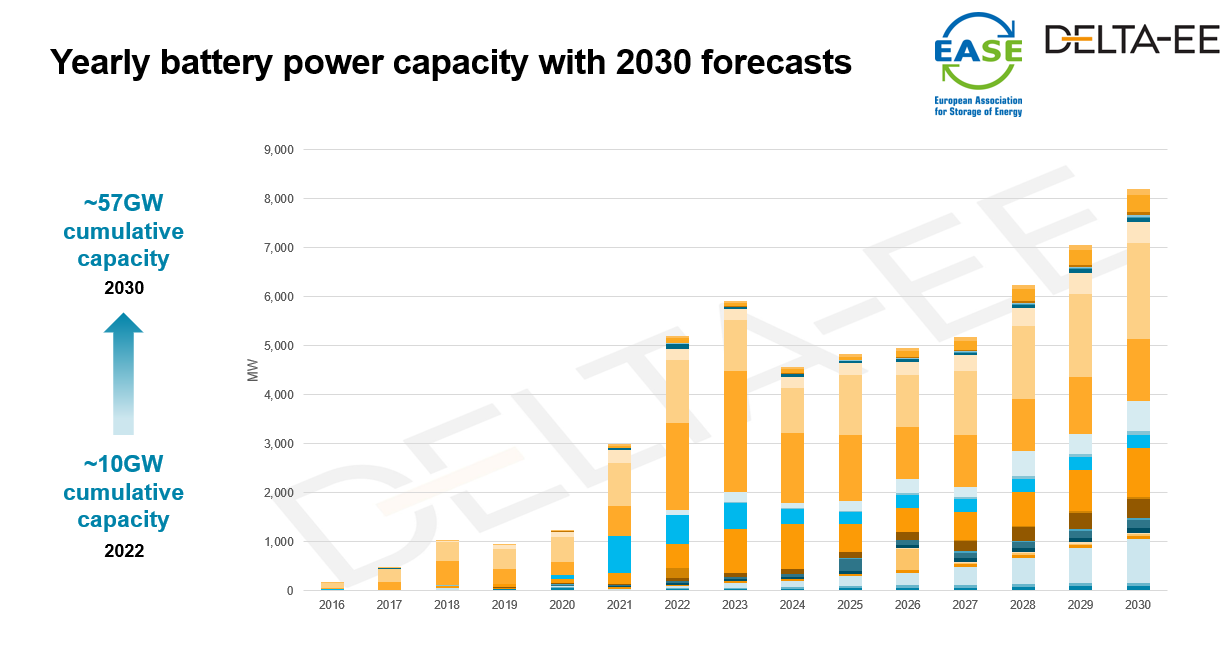
2022 will be a milestone year with > 5GW of new installations and >10GW of cumulative battery capacity. However, supply chain issues and raw material shortage is resulting in fewer installations into 2023 and 2024.
Cumulative battery power capacity by 2030 is expected to be ~57GW. In order to achieve climate ambitions, renewable targets and guarantee security of supply EASE has set a target of ~200GW of storage by 2030. This target is unlikely to be meet without additional support.
Front-of-meter batteries dominate both exsisting and new installations with limited capacity across both the residential and commercial and industrial sectors, with the exception of Germany and Italy. The former holds the largest residential market with ~200,000 annual installations whilst Italy is experiencing rapid growth due to government capex subsidies.
EASE has published an extensive review study for estimating Energy Storage Targets for 2030 and 2050which will drive thenecessary boost in storage deployment urgently needed today. Current market trajectories for storage deployment are significantly underestimating the system needs for energy storage. If we continue at historic deployment rates Europe will not be able to integrate the rapidly growing renewables and will fall short of its 2030 and 2050 climate targets.
Not a member yet ?
Explore the benefits of joining Energy Storage Europe
Energy Storage Europe welcomes the European Commission's growing focus on cybersecurity in the energy sector and supports the direction of travel across the Cyber Resilience Act (CRA), the Network Code on Cybersecurity, and the proposed Cybersecurity Act (CSA) 2.0. Yet raises concerns that require targeted corrections to ensure these frameworks deliver on their security objectives without inadvertently slowing battery storage deployment.
Energy Storage Europe replies to the European Commission’s public consultation on the Methodology for the Calculation of the recycled content of industrial and EV batteries. Under the Batteries Regulation, several categories of batteries, including industrial batteries, will have to contain a certain percentage of recycled metals to be allowed to be placed on the EU market.
Energy Storage Europe welcomes the proposed revision of the Network Code for generators and the explicit integration of storage, including grid-forming capabilities. Further clarity is needed on requirements for bidirectional storage and the treatment of existing projects.