EASE has provided a response to the European Commission's Public Consultation on the new Batteries Regulation to further improve it in a way that is favourable to the energy storage sector. This Regulation aims to ensure that batteries placed in the EU market are sustainable and safe throughout their entire life cycle.
March 2021 / Reports and Studies
Power-to-Gas: Policies and Actions in Europe
EASE has prepared an overview of the upcoming and existing key policy and actions of Spain, the Netherlands and Germany to support the uptake of hydrogen and Power-to-Gas solutions.
Hydrogen and Power-to-Gas are chemical energy storage technologies; one of five energy storage “families” identified by EASE. Electricity-produced hydrogen can be used for transport (fuel), for heating (fuel), as a raw material (chemical feedstock); to balance electricity demand and supply and to support the management of the electricity grid (through storage).
The European Union, and many of its Member States, consider clean hydrogen a key priority to achieve the European Green Deal and Europe’s clean energy transition. Yet, today, hydrogen is a modest fraction of the European energy mix.
EASE welcomes the two strategies presented by the European Commission in 2020, the Energy System Integration and Hydrogen. While it seems clear that coordination at the European Union level is necessary, different states are trying to introduce complementary policies and initiatives to favour its uptake. It seems one-size-fits-all solutions may not exist – States have different characteristics and priorities, so different approaches are necessary.
In this document, we will focus solely on hydrogen produced through Power-to-Gas, i.e. by electrolysis. Other technologies to produce hydrogen are not considered.
EASE has provided a response to the European Commission's Public Consultation on the new Batteries Regulation to further improve it in a way that is favourable to the energy storage sector. This Regulation aims to ensure that batteries placed in the EU market are sustainable and safe throughout their entire life cycle.
Not a member yet ?
Explore the benefits of joining Energy Storage Europe
Energy Storage Europe replies to the European Commission’s public consultation on the Methodology for the Calculation of the recycled content of industrial and EV batteries. Under the Batteries Regulation, several categories of batteries, including industrial batteries, will have to contain a certain percentage of recycled metals to be allowed to be placed on the EU market.
Energy Storage Europe welcomes the proposed revision of the Network Code for generators and the explicit integration of storage, including grid-forming capabilities. Further clarity is needed on requirements for bidirectional storage and the treatment of existing projects.
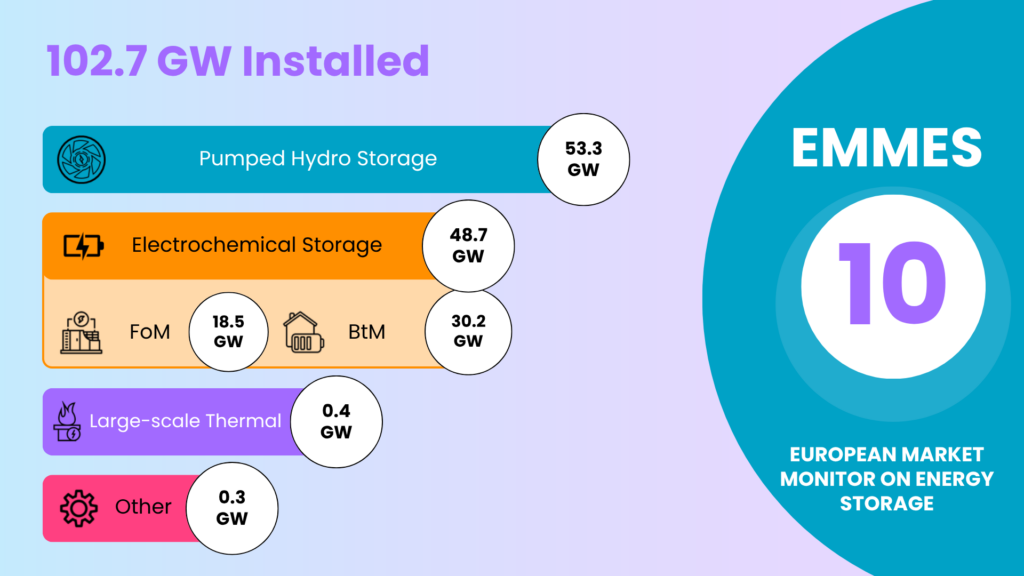
In 2025, Europe surpassed 100 GW of installed storage capacity for the first time, and by Q2 2026 storage overtook nuclear as a source of installed power capacity. With electrochemical storage forecast to grow by a further 153 GW by 2030, energy storage is becoming a core pillar of Europe's future electricity system.
In 2025, Europe surpassed 100 GW of installed storage capacity for the first time, and by Q2 2026 storage overtook nuclear as a source of installed power capacity. With electrochemical storage forecast to grow by a further 153 GW by 2030, energy storage is becoming a core pillar of Europe's future electricity system.